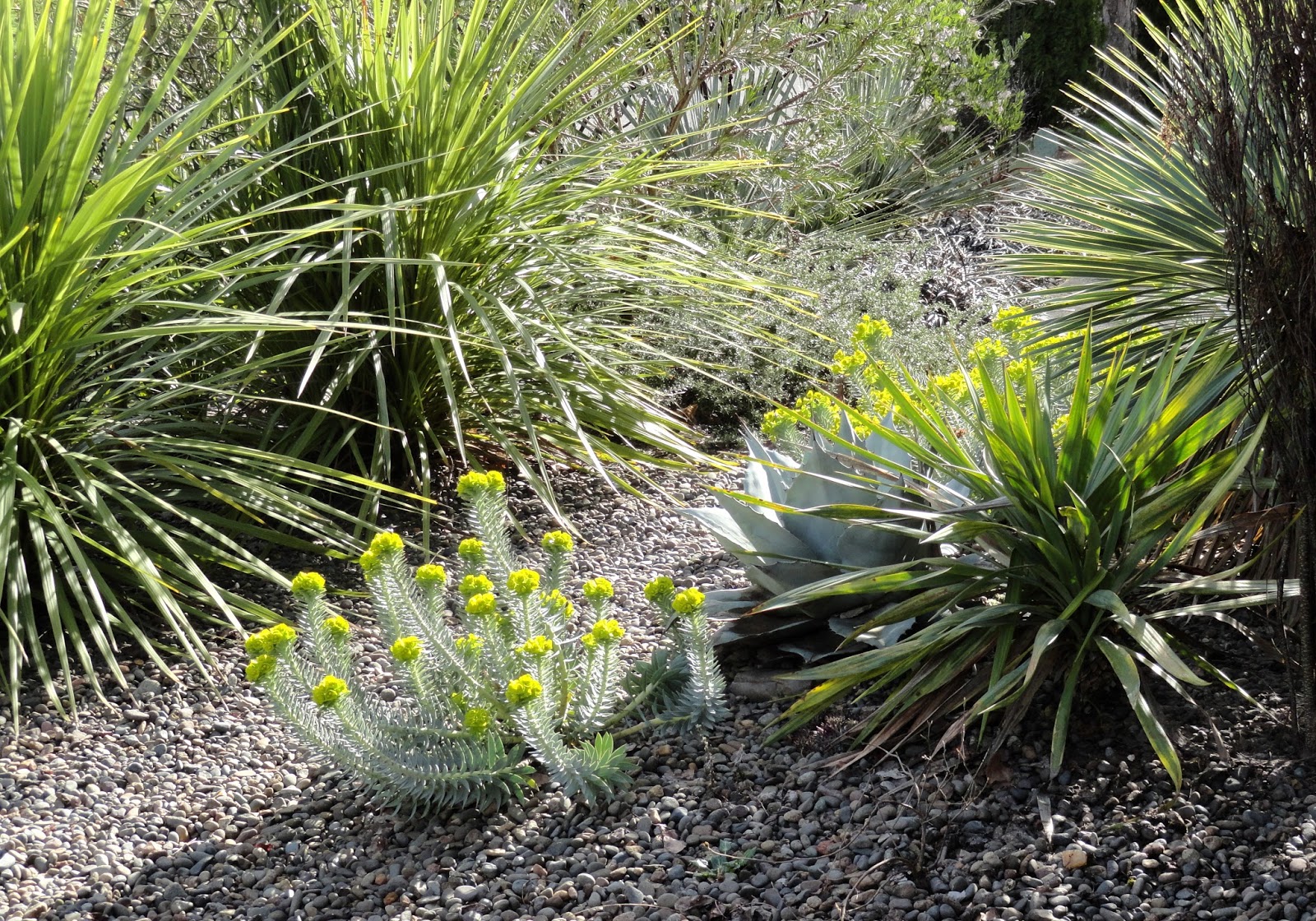
It's time to share how things are doing after record winter rainfall (over 27" since the beginning of December) and a snow and freezing rain event back in early January. By "things" I mean the ones that were experiments, technically USDA Zone 9-ish plants left out and/or my Agaves and other succulents that are planted out in the ground. The very wet ground. And this is gonna be a long post. I let the camera finger get a little carried away!
Let's start in the back garden. Last year I had two orange blooming Anigozanthos (Kangaroo Paw) in containers on the patio. Since they were small I went ahead and tucked them into the SPGreenhouse, what the heck. The heater was on when it got down to 24F outside and look, they're still alive! (they're the green strappy-leaved things)
The Asparagus densiflorus 'Myers' planted out in the ground is still alive too...and obviously I need to get started on clean up! (pine-cones everywhere...)
The Grevillea 'Superb' – well it's not exactly dead (yet)...
Leucadendron 'Silvan Red' is looking good. A few leaves have turned brown though, I hope I'm not jinxing it!
You might recall there was an Echium candicans 'Variegata' I had hopes for, but it's a gonner and already composted. The E. fastuosum got hit hard by the cold/ice...
But there is new growth popping up all along the stems, so that's cool!
Salvia apiana is not looking good.
Grevillea 'Ivanhoe', of the three plants in my garden this one looks the best – but they're all still alive.
I meant to dig these little Agave pups and the Opuntia before winter – they're not planted in particularly well drained soil – but forgot. It doesn't look to be bothering them much though, perhaps the palm is taking up most of the water.
The smaller pups on the far right in this photo are basically rotting away, thankfully the larger guys seem to be fine, only minor damage on their lower leaves.
Agave bracteosa continues to be a super-star...
And Agave 'Mateo' is showing off the coping skills of it's one known parent, A. bracteosa
Agave striata is looking like a champ.
The Agave parryi 'JC Raulston' pup has some rot, as does Echeveria secunda...but...unless things get worse (like a really wet and cool spring...it could happen, but I am praying that it doesn't) they should make it...yay!
Agave gentryi ‘Jaws’ has a tumor, or two.
But overall looks really good. That's Agave gracilipes at about 12:00 and another 'JC Raulston' pup just under it. Grevillea x gaudichaudii is creeping in from below.
Grevillea x gaudichaudii has some foliage damage, but other branches (see above) look fine.
Unlike what used to be a cute little Agave parryi trio. They're not going to pull through...
The trio of Agave parryi dish planters however, no problem!
Here's where I admit I've lost track of what some of these Agaves are. I believe this one came from the Agave rescue, but maybe not.
This one did for sure, and as you can see it's really unhappy. It was knocked back hard the winter of 2013/14 and had made a valiant recovery. I don't know if it's up for doing it again.
On the left Dyckia choristaminea 'Frazzle Dazzle' joined by another Agave without a name. I divided a huge 'Frazzle Dazzle' last spring and planted out a few pieces. This one doesn't look like it's going to make it.
This one has a chance...
When last we saw this Opuntia polyacantha it was bent over in half and covered with ice. I like this version better.
Let's move out to the driveway where the humongous Agave weberi is holding court.
He's got some bad spots, which indicate future arm amputations, but all in all he's looking grand.
Ditto for his friends next door who've spent all winter out in the wet – except for the period with the snow and ice, I managed to grab them before that hit, the only thing I did to prepare.
Now we're out in the front garden and here's the big (for me) surprise...four of my seven Echium wildpretii are still going strong!
When these guys were encased in ice I figured that was the end, but they pushed on through...here's to summer blooms! (fingers crossed)
This Agave americana (yes, that's really what it is) has already gone through surgery.
It lost a few arms. As you can see in the photo above there's another one that's got the crud. I'll leave it until it gets worse and we (hopefully) have a dry spell forecasted.
This little Echinocereus triglochidiatus v. gonacanthus keeps on keeping on!
And Agave 'Silver Surfer' is spotless (although not terribly silver, is he?)
Agave americana var. protoamericana, another "rescue" who came back from the brink a couple years back. Can he do it again?
Agave parryi 'JC Raulston', with a dusting of Arctostaphylos x 'Austin Griffiths' flowers...
All the A. parryi 'JC Raulston' look great.
I love this plant!
Agave ocahui has some ugly damage to it's older leaves, but the center still looks good.
Gross!
Agave ovatifolia, this one started life here has a tiny little pup...it's doing well, but will be loosing an arm.
Ditto for this one.
The leaning Opuntia is a lasting result of the cold and ice, I keep hoping it will upright itself (like they often do) but I'm beginning to think I'll need to prop it up.
The Agave americana it seems to be protecting is doing fine.
The Ochagavia carnea has been in the ground since spring of 2014 and is starting to clump up. No issues with the cold, wet, or ice.
This little Agave lophantha 'Splendida' pup didn't fare so well. I wonder if a larger plant would have done better?
I planted this pair (Agave americana and Agave americana var. protoamericana) last fall as part of the OCK planting. Normally I wouldn't dream of planting Agaves so late in the season, but I was feeling daring. The A. americana has had some issues (you can see the amputation scars) but overall I think it's going to be okay.
Agave utahensis, doing well.
Saxifraga taygetea 'Rotundifolia', is also fine – despite its USDA Zone 10 label (which must have been an error). I regret that I didn't visit Sky Nursery when I was in Seattle a couple weeks ago and buy a few more! (what was I thinking?)
*Sigh* so beautiful! I was shocked when I looked back at an old post (2013) and saw how small this Agave ovatifolia was when I planted it. Completely unscathed by winter, yay!
The ugly puncture wound you may have noticed came from when we got our windows replaced last spring, the dots all around it from a hail storm.
But I have no idea when this big slice occurred, thankfully they're both on lower arms and can be removed later if need be.
This is the second A. ovatifolia planted in that same general area, and congrats! With that you've reached the end of a very long post...(kind of like our very long wet winter). Here's to warming, drying, weather...soon!
All material © 2009-2016 by Loree Bohl for danger garden. Unauthorized reproduction prohibited and just plain rude.
Friday, March 4, 2016
Thursday, March 3, 2016
I love you Corona! (or how procrastinating paid off)
You've heard me complain — this winter has been wet, very wet. We've broken all sorts of records for precipitation. Skies like this one (on February 2nd to be exact) with that beautiful shade of blue, have been rare.
When I decided to plant an Agave ovatifolia in this large container I knew it wouldn't be going anywhere over the winter (too heavy), so I built a little cover for it out of PVC and an old shower curtain (that story here). Last winter was such the cover came off frequently, this wet winter however, has meant it's stayed on, a lot. Too much...
We have a problem.
Yuck, and on an inner leaf too...
How to get in there and cut it out without creating an even larger problem by damaging the leaves around it?
Well I did like anysmart lazy person would do and put that off for another day...
Wednesday February 24th was that day. It had gotten a lot worse over those three weeks.
My usual tool for cutting off rotting Agave arms is a serrated steak knife, it works like a charm. However there was no way to get in there and cut without doing damage to the other leaves. I tried a couple of my other snips and pruners but none were up for the job.
Then I got an idea! What about those odd curved grape snips Corona put in the swag-bag I received at the NWFG Show tweet-up?
I remembered looking at them and thinking they were strange, what with their long curved blades and small body.
But there couldn't have been a better tool for the job.
They fit in there perfect, the curve echoed the natural shape of the agave, and they were so sharp that cutting was effortless.
No other leaves damaged in the process!
The finished job. I had this same thing (a rotting inner leaf) happen on an Agave victoriae a few years back. It was easy to get to though and once I cut out the offending appendage the wound dried up and the plant is still alive and looking great.
Gross right?
Look what the "skin" is doing, it's like thin vellum...
The surgery was followed by two dry days, now the rain has returned and the cover is back on. Fingers crossed everything will be okay. Oh..and tomorrow we'll look at how the rest of my garden is doing post-winter...(ya, it's meteorological spring and that's good enough for me...). Meanwhile, thank you Coronal Tools! (and the moral of this story...if you wait long enough to do an unpleasant task the right tool just might fall into your hands!)
All material © 2009-2016 by Loree Bohl for danger garden. Unauthorized reproduction prohibited and just plain rude.
When I decided to plant an Agave ovatifolia in this large container I knew it wouldn't be going anywhere over the winter (too heavy), so I built a little cover for it out of PVC and an old shower curtain (that story here). Last winter was such the cover came off frequently, this wet winter however, has meant it's stayed on, a lot. Too much...
We have a problem.
Yuck, and on an inner leaf too...
How to get in there and cut it out without creating an even larger problem by damaging the leaves around it?
Well I did like any
Wednesday February 24th was that day. It had gotten a lot worse over those three weeks.
My usual tool for cutting off rotting Agave arms is a serrated steak knife, it works like a charm. However there was no way to get in there and cut without doing damage to the other leaves. I tried a couple of my other snips and pruners but none were up for the job.
Then I got an idea! What about those odd curved grape snips Corona put in the swag-bag I received at the NWFG Show tweet-up?
I remembered looking at them and thinking they were strange, what with their long curved blades and small body.
But there couldn't have been a better tool for the job.
They fit in there perfect, the curve echoed the natural shape of the agave, and they were so sharp that cutting was effortless.
No other leaves damaged in the process!
The finished job. I had this same thing (a rotting inner leaf) happen on an Agave victoriae a few years back. It was easy to get to though and once I cut out the offending appendage the wound dried up and the plant is still alive and looking great.
Gross right?
Look what the "skin" is doing, it's like thin vellum...
The surgery was followed by two dry days, now the rain has returned and the cover is back on. Fingers crossed everything will be okay. Oh..and tomorrow we'll look at how the rest of my garden is doing post-winter...(ya, it's meteorological spring and that's good enough for me...). Meanwhile, thank you Coronal Tools! (and the moral of this story...if you wait long enough to do an unpleasant task the right tool just might fall into your hands!)
All material © 2009-2016 by Loree Bohl for danger garden. Unauthorized reproduction prohibited and just plain rude.
Wednesday, March 2, 2016
Wednesday Vignette: determination
Above: Euphorbia rigida seedlings sprouting in a crack between the foundation and driveway of my neighbor's house. Below: the parents, in my garden.
Approximate distance traveled = 10 feet. Wednesday Vignettes are hosted by Anna at Flutter & Hum.
All material © 2009-2016 by Loree Bohl for danger garden. Unauthorized reproduction prohibited and just plain rude.
Tuesday, March 1, 2016
In a Wooden Container on Tuesday...
Some of you may have seen this image on Instagram a couple of weeks ago. I was so excited about my new Bayce I had to share what a great base it made for my woven lamp. As I noted then, Lila seems to approve.
Are you wondering what the heck a Bayce is? Well then you must not follow Allan's blog It's Not Work it's Gardening where he's written about his new company, Nimble Mill. The Bayce is a "plant container or plant stand with a beautiful, two-toned look. The upper section is made of cedar in its natural colors, while the base is pine and available in a variety of colors." The Bayce is joined by the Worn, Trang, Druhm, and mini-Bayce (that's for now, being the creative type I'm pretty sure he's probably already cooking up other designs). Here are a few photos "lifted" from his website....
Alan personally designs and builds each piece, it's been a pleasure to watch him develop and launch the product line. I've drooled over the simple clean designs and rich colors, so when Alan asked if I'd like to receive a Bayce to try-out and review on my blog I wasted no time in saying "yes please!" What he had no way of knowing was how well the design fit with other furniture already in my home...
See the theme?
Evidently I have a thing for rounded corners.
And dark wood. Isn't that dark base dreamy?
As are the natural tones and patterns of the wood, which are enhanced by the simple treatment they receive.
Signed and numbered (I got #1?!). Details like this make me happy.
And it's not just about the aesthetic details, Alan pays attention to the functional ones as well. He includes two wooden blocks/risers with each Bayce. Using one, or both, in some fashion can help any container achieve the right height within the Bayce, since you're not planting directly in it, but rather using it as a sort of decorative cache-pot.
I decided to use my Bayce to hide the ugly legs on my Zingiber malaysianum 'Midnight', so no riser was needed. I wanted the plant to sink in as far as possible.
That's better!
Love that foliage...
This plant will go back outdoors when the temperature rise, but it's spent winter hiding in a corner of the "media room" (a fancy name for the extra bedroom where a TV and computer live). Now it gets to come out and join us in the living room. And you probably picked up on the fact the title of this post is a play on "In a Vase on Monday" the wildly popular meme that has us gardeners filling a vase with cuttings from our gardens.
Perfect! Although truth-be-told I scooted it out a bit to get a better photo of it.
Here's where it's actually placed. Oh and don't worry about that heat-vent behind it, it's not used.
Because the Bayce is so darn versatile I have no doubt this is just one of a million different ways I will use it...thanks Alan for letting me try it out! Curious to see more? Visit Nimble Mill. Oh and as Alan notes on his website, he's welcoming dealer inquiries!
All material © 2009-2016 by Loree Bohl for danger garden. Unauthorized reproduction prohibited and just plain rude.
Are you wondering what the heck a Bayce is? Well then you must not follow Allan's blog It's Not Work it's Gardening where he's written about his new company, Nimble Mill. The Bayce is a "plant container or plant stand with a beautiful, two-toned look. The upper section is made of cedar in its natural colors, while the base is pine and available in a variety of colors." The Bayce is joined by the Worn, Trang, Druhm, and mini-Bayce (that's for now, being the creative type I'm pretty sure he's probably already cooking up other designs). Here are a few photos "lifted" from his website....
Alan personally designs and builds each piece, it's been a pleasure to watch him develop and launch the product line. I've drooled over the simple clean designs and rich colors, so when Alan asked if I'd like to receive a Bayce to try-out and review on my blog I wasted no time in saying "yes please!" What he had no way of knowing was how well the design fit with other furniture already in my home...
See the theme?
Evidently I have a thing for rounded corners.
And dark wood. Isn't that dark base dreamy?
As are the natural tones and patterns of the wood, which are enhanced by the simple treatment they receive.
Signed and numbered (I got #1?!). Details like this make me happy.
And it's not just about the aesthetic details, Alan pays attention to the functional ones as well. He includes two wooden blocks/risers with each Bayce. Using one, or both, in some fashion can help any container achieve the right height within the Bayce, since you're not planting directly in it, but rather using it as a sort of decorative cache-pot.
I decided to use my Bayce to hide the ugly legs on my Zingiber malaysianum 'Midnight', so no riser was needed. I wanted the plant to sink in as far as possible.
That's better!
Love that foliage...
This plant will go back outdoors when the temperature rise, but it's spent winter hiding in a corner of the "media room" (a fancy name for the extra bedroom where a TV and computer live). Now it gets to come out and join us in the living room. And you probably picked up on the fact the title of this post is a play on "In a Vase on Monday" the wildly popular meme that has us gardeners filling a vase with cuttings from our gardens.
Perfect! Although truth-be-told I scooted it out a bit to get a better photo of it.
Here's where it's actually placed. Oh and don't worry about that heat-vent behind it, it's not used.
Because the Bayce is so darn versatile I have no doubt this is just one of a million different ways I will use it...thanks Alan for letting me try it out! Curious to see more? Visit Nimble Mill. Oh and as Alan notes on his website, he's welcoming dealer inquiries!
All material © 2009-2016 by Loree Bohl for danger garden. Unauthorized reproduction prohibited and just plain rude.
Subscribe to:
Posts (Atom)