Friday, May 6, 2022

So many mahonia! A look at my collection...

Recently I began toying with the idea of a post detailing my surprisingly large mahonia collection—surprising because I wouldn't say this is a genus I am particularly enamored with, yet I've managed to accumulate 23 plants representing 13 different species or cultivars...

By far the largest plant in my collection is Mahonia x media 'Charity', even after I've chopped off a considerable number of branches due to them flopping after a heavy snow or ice load. 

'Charity' grows on the north side of our house, bordering our neighbor's driveway. I may have been more patient and held off on the chopping if it was my car the plant was flopped on, but I can't expect that from them.
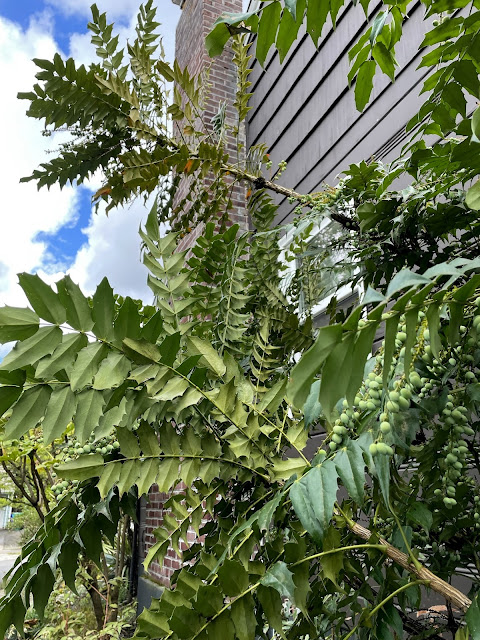
The flowers and following fruit are very popular with the neighborhood birds.
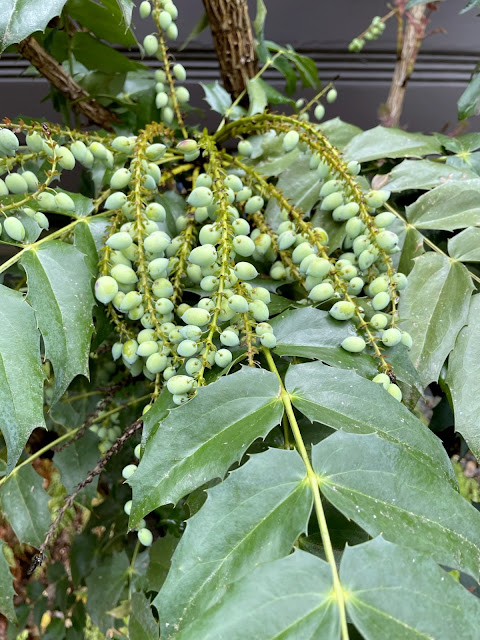
Flowers—I suppose it's worth pointing out I'm intentionally not including photos of the flowers in this post. The foliage of many mahonia—especially the colorful spring growth—is so much more interesting than the small yellow flowers typical of this genus. At least to me...
The blooms are however great for feeding the wildlife especially during times when there isn't much else happening in the garden.

This sickly specimen is Mahonia fortunei ‘Dan Hinkley’. Last year I gave it a hard prune to get rid of the less than attractive foliage bits, but it's looking pretty sad yet again and it's probably time to get the shovel and really prune that baby right on out of here.
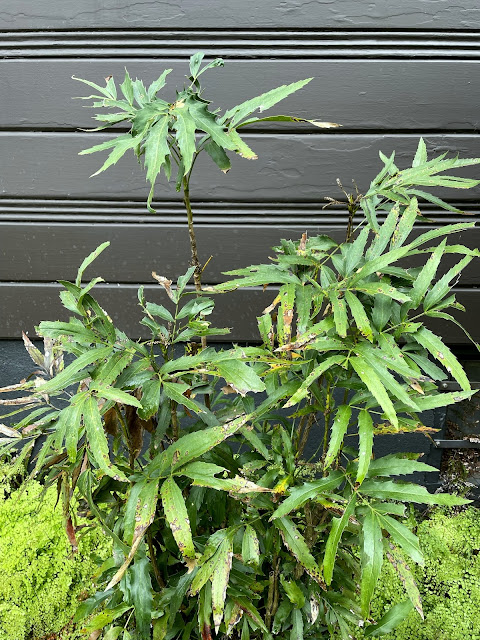
Nearby however is a tiny cutting I rooted, and seems to be doing pretty well—no spots—so perhaps the plant will live on after all.
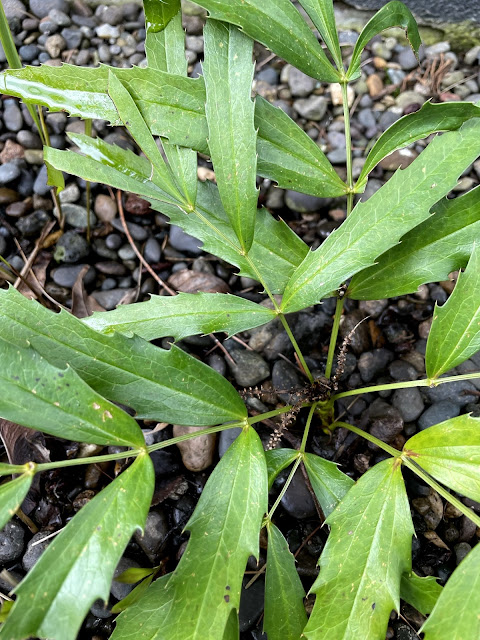
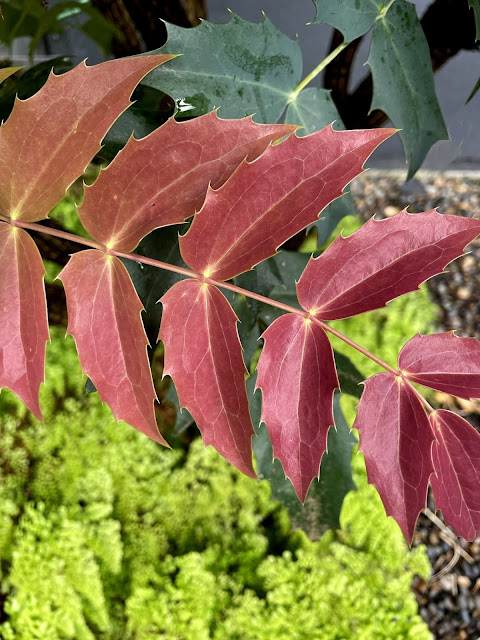
Next up, Mahonia nervosa—aka dwarf Oregon grape, Cascade mahonia, or dull Oregon grape—is native from British Columbia to California and east into Idaho.
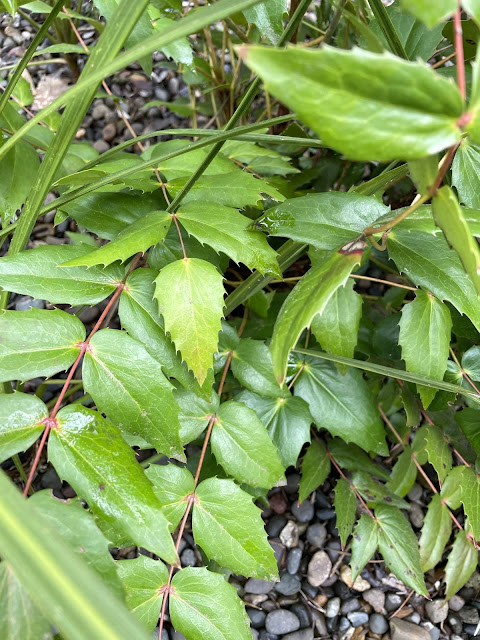
The name nervosa means conspicuously veined, but I love this one because it takes on a vibrant purple tone in the cooler months.

I have a pair of Mahonia gracilipes, but this is by far the largest and most impressive.

Here's a slightly earlier photo of the new growth, when it was extra vibrant.

The underside of the leaves are stark white, one leaf is turned here displaying that coloration.
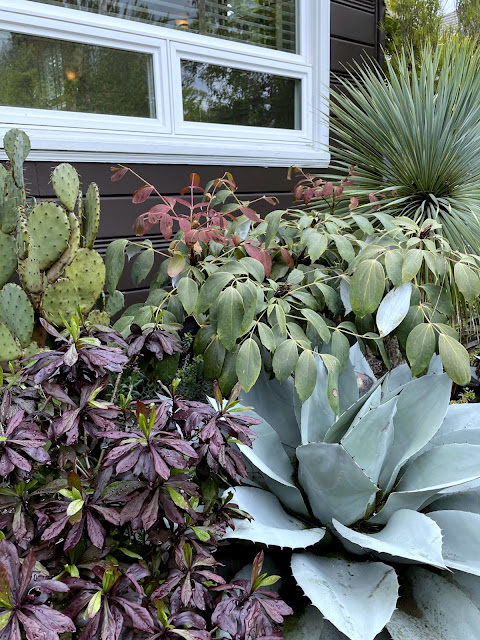
I used to have a pair of Mahonia confusa 'Narihira' (plants Monrovia gave me to trial), but one of them looked so horrid after winter 2020/21 that I dug it out. This one was only slightly better then, but it has grown out of the uglies and is looking quite fetching now.

The big leaves at the bottom of the above photo belong to rodgersia, I do love me some rodgersia.

Mahonia eurybracteata 'Soft Caress', or as Andrew calls it the "palm mahonia" is one of those plants you can work in just about anywhere.

As proof I now have five and would have more if they weren't so hard to find and a little on the expensive side.

Here's another Mahonia fortunei, this one is 'Curlyque' and it doesn't have the gunky spots that ‘Dan Hinkley’ has. Well, unless I have that backward and this is actually Dan. Hmm, I've confused myself.

Moving on, here's my oldest, largest—and if I do say so myself quite impressive Mahonia eurybracteata 'Soft Caress'. It's embracing Mahonia eurybracteata 'Indianola Silver'.

A better focus on Mahonia eurybracteata 'Indianola Silver'...

The new growth is pretty spectacular.

There are actually two Mahonia eurybracteata 'Cistus Silvers' in this photo. The largest isn't yet planted, the pot is just sitting there. Last year's plant is tiny—up and to the right, I'm still waiting for that one to push out new growth.

This little darling came from my Miller Garden visit last fall. Richie Steffan gave me two Mahonia x sevillana—a hybrid between M. eurybracteata and M. gracilipes. This one favors its eurybracteata parent whereas the other (which I didn't take a photo of) favors the gracilipes side. It's going to be fun to watch them develop.

Speaking of Mahonia gracilipes, that's not what this is. This bright green number is Mahonia gracilis and I own it only because I wasn't paying attention. 

Prior to a Cistus nursery visit, I was looking through their catalog offerings and thought I was asking for a Mahonia gracilipes, instead it was Mahonia gracilis. Oh well, I'm always up for learning about a new plant.

This oddly formed beauty is Mahonia x media 'Marvel' one of three I have, it's a Sunset Garden Collection plant...
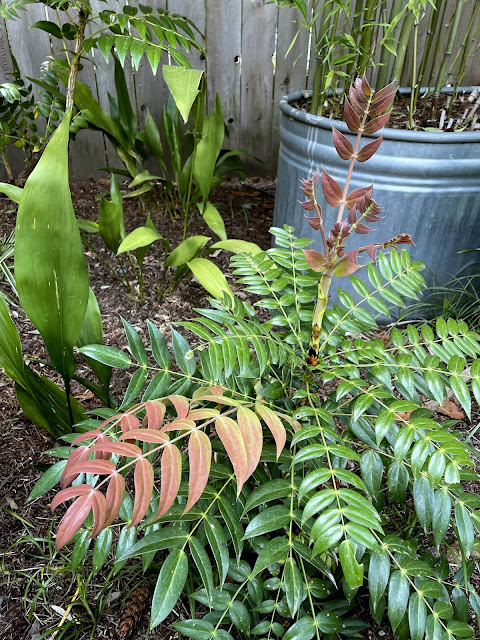
This version of "x media" is softer than 'Charity', but just as floriferous and thus rich with berries.
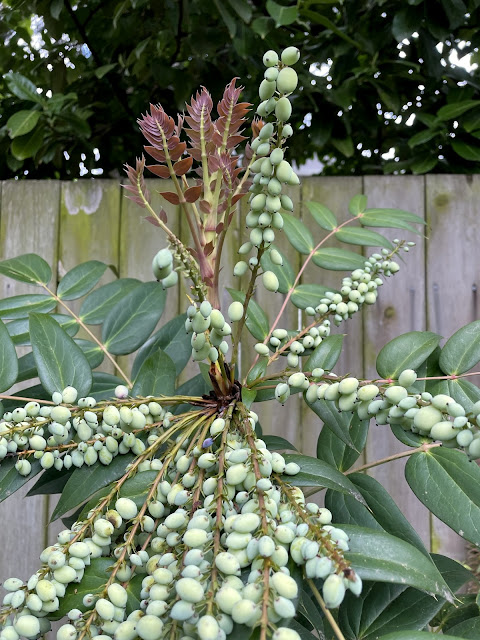
The new growth is absolutely spectacular.
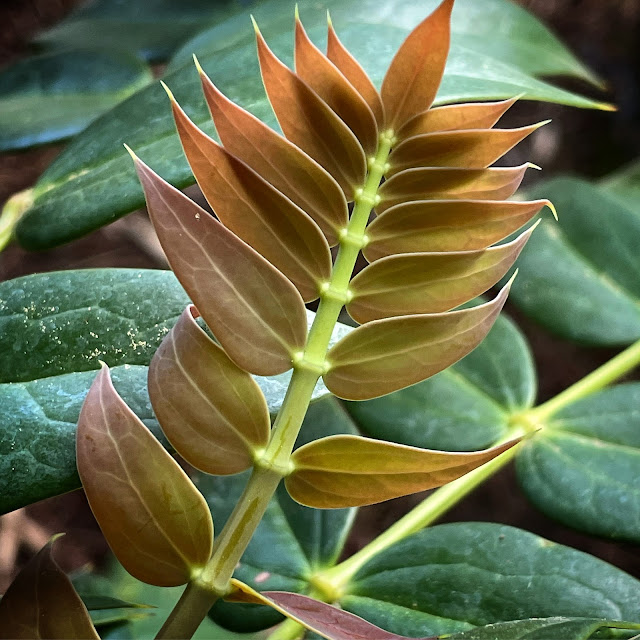
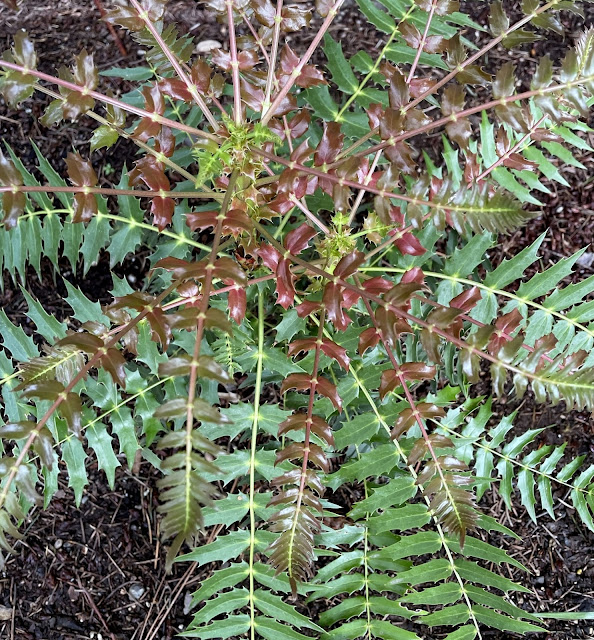
The last mahonia in my collection is Mahonia lomariifolia ssp. tenuifolia. I fell hard for this plant when I saw it in Sean Hogan's garden.
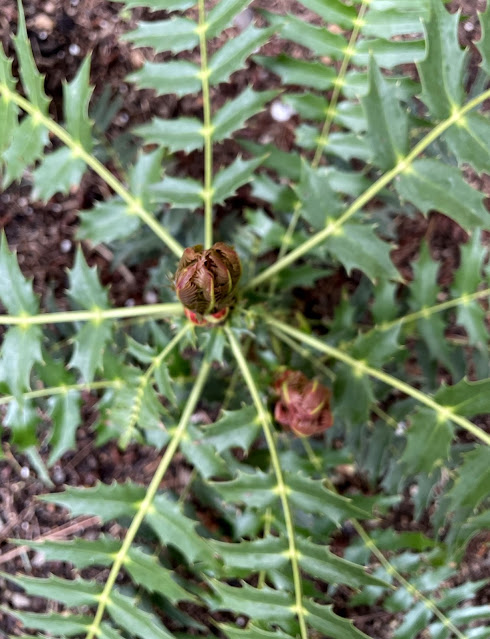
New growth...
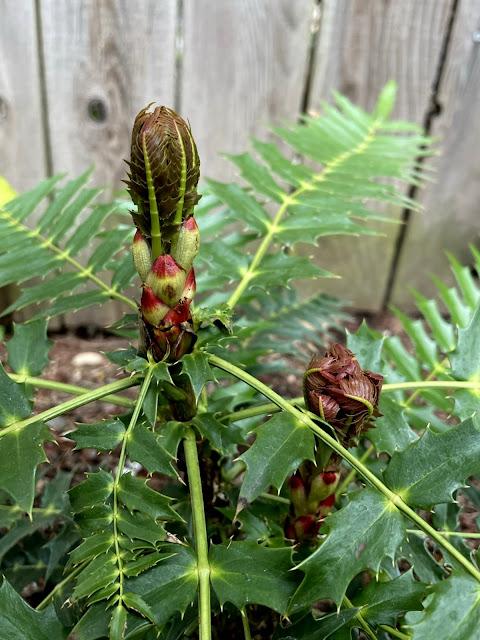
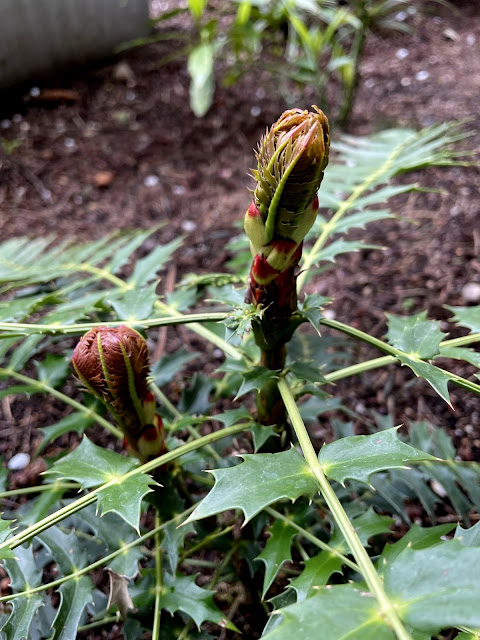
Here it is a little further along and still holding that red coloration. 
So that's it for my mahonia. I wish these photos were of each plant at its best, instead I just snapped phone photos as I was working int he garden one day, so some of the light conditions are not good. Oh well, if I'd have waited to get a great shot of each I never would have gotten around to writing this post—we make compromises. So, tell me about your mahonia...

All material © 2009-2022 by Loree Bohl for danger garden. Unauthorized reproduction prohibited and just plain rude.

Wednesday, May 4, 2022

Visiting two very different gardens in the Seattle-area

I was surprised to discover I still had photos from our February trip up to Seattle (for the NWFG Fest) waiting to be published—today we take a quick look at two very different gardens, starting with the Rhododendron Species Botanical Garden. I stopped on our way up to Seattle, but unfortunately had less than an hour before they closed. I shopped the nursery and then cut through the garden to the fern stumpery.

Pyrrosia!

I think the large fronds belong to Woodwardia unigemmata, the jewelled chain fern.

Blechnum spicant (deer fern) and Blechnum penna-marina (alpine water fern). 

I've heard a few people disparage the spreading nature of Blechnum penna-marina, but for now I'm loving how it's starting to expand in my garden—nothing like the enthusiasm shown here though.

Hydrangea integrifolia climbing the tree. 

I can't tell you the name of the round-leaved ground cover, maybe you know and can tell me?

Bleached blades of hakonechloa, Japanese forest grass. Spring clean-up was still a few weeks off. I love seeing this grass left to age gracefully in place.

Oh, I think I know the name of the plant with the little round leaves in this photo, Lonicera crassifolia.

More quickly taken photos...
Everything was very green!

Polypodium scouleri

Saxifraga dentata

Woodwardia unigemmata and Cyrtomium falcatum (Japanese holly fern), I believe.

Rhododendron sinogrande, looking a little deflated.

Saxifraga stolonifera and a bright green bed of moss.

This is the end of the shady Rhododendron Species Botanical Garden coverage...

... as we transition to the sunny Pacific Connections Garden at the Washington Park Arboretum.

These two gardens (the RSBG and PacConn) book-ended our five day trip, this was our last stop before we hit the road back to Portland. 

Some kind visitor placed this camellia blossom where it could be appreciated.

The Pacific Connections Garden contains plants from five countries connected by the Pacific Ocean—Cascadia, Australia, China, Chile and New Zealand. Well, make that four countries and one region.

These stalks belong to Cardiocrinum giganteum, from China.

The odd black cylinders must be protecting the small plants that will grow to bloom in the coming years? Perhaps from nibbling rabbits?

I don't think I would have noticed the large fern on the roof of the shelter had Andrew not been looking up. 

Hebe ochracea ‘James Stirling’ (in the foreground) is such a stunning plant.

It's at the entrance to the New Zealand Forest.

The Seattle area had an epic cold winter and those cordylines are showing their displeasure with odd coloring at their growing point. 

There were many astelia that didn't look like they were going to make it. This was one of the good ones.

Ditto for the phormium.

Astelia nivicola 'Red Devil' has been one of the best performers of the genus for me.

The Cordyline indivisa hadn't melted yet, but they look a little off in their coloring.

Ditto for the Wollemia nobilis

It should pull through.

It's been amazing to watch this garden mature over the years, I hope it's not set back to hard as the plants react to the historic cold.

Grevillea x gaudichaudii

And the pendulous blooms of Garrya elliptica (Coast silk-tassel) end this look at two very different gardens, both of which I love to visit every chance I get.

All material © 2009-2022 by Loree Bohl for danger garden. Unauthorized reproduction prohibited and just plain rude.

Monday, May 2, 2022

Tortured palms, beautiful bamboo and a mushy agave...

Today's post is a three-parter, first up, the tortured palms. I spotted them in parking lot on the way to the Oregon Coast, I can't remember exactly where it was, but we pulled off to get gas and my mouth dropped open...

What exactly were they hoping to accomplish with the plastic wrap? 

There's no insulating factor, what with a single layer of plastic and huge gaps. So it wasn't winter protection—or at least good winter protection. Were they trying to keep the trunks dry? But why?

Honestly it looked like some weight-loss scheme you would have seen on a 70's sitcom like Laverne & Shirley, wrap yourself in plastic and lose 5 pounds overnight!

Next topic; bamboo. When I visited the Wonder Garden in Manzanita, OR, I also wandered next door to check out the landscaping at the Coast Cabins.

It was this view that caught my eye as we drove by, naturally I had to walk back and get a closer look. Never mind that sign saying the grounds are for registered guests only—I was quick and only traveled the main pathway.


Be still my heart! So lovely.


Communal marshmallow roasting opportunity. 

Thankfully there aren't many ice-storms here at the beach to wreck havoc on the beautiful bamboo.

The third and final part of this post—the mushy agave, an Agave parrasana 'Globe'.

This plant is (was) in my garden, where looked fantastic all winter—until suddenly it didn't. I grabbed the container intending to change out the plant for something less tragic, and that's when I spotted...

... a speared slug! How perfect. Gruesome, yes. But perfect.

All material © 2009-2022 by Loree Bohl for danger garden. Unauthorized reproduction prohibited and just plain rude.